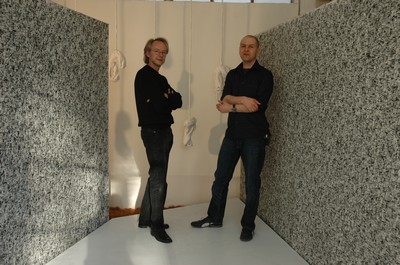
Haruko & Oggenfus
Text by Barnaby Drabble for the K3 exhibtion
Its Spring in Zürich, but someone has convinced the weather that its still Winter. A cruel, grey wind sets about stripping the trees of the little blossom they have managed to muster this year. The river, swollen and brown, carries dark shapes downstream with an ugly energy, and the rain, which has fallen for almost a week, lets up for a short moment as if taking breath before a further onslaught. In this welcome break two men spill out of the Big Ben pub onto the pavement, pulling their jackets close around them and aiming wrinkled noses at the dark sky.
The younger of the two is drunk and although dressed smartly when he entered the bar, his dark suit seems to fit him poorly now, bunched in creases around his waist with the collar half turned up against the weather. His thin black tie hangs loosely like a gallows rope around the collar of his shirt, which is open to the third button revealing a lonely tuft of chest hair. He shouts something excitedly in French in the direction of his companion, an older, taller, statelier figure who appears not to listen, aware perhaps that the wind is audience enough for whatever is being proposed.
The older man is dressed for the spring that didn’t come. His high-waisted pale trousers offset with a flamboyant bow tie standing proudly above the collar of his still immaculately pressed, but woefully thin, overcoat. His hands are calmly busy, the left clutching his hat, a straw boater, tightly to his head and the right smoothing his long moustache as if teasing out the smoke from the bar they have left behind. Occasionally acting as an anchor for his stumbling companion, he walks slowly pausing from time to time as if to admire the dismal view afforded by this stretch of Hardstrasse on a cold, wet night.
They meander forwards and come to rest at the crossing, where the lights glare red. There is not a car in sight but uncharacteristically these two men of letters, unequalled minds of the 20th century, choose to wait. We are, after all, in Switzerland.
Georges Bataille and Raymond Roussel are on their way to an opening at K3 Project space.
The two have spent the last four hours in literary discussion. Bataille intent on persuading his new friend that his work Histoire de l’oeil has been fundamentally misunderstood by the critics, its philosophical intention overlooked in favour of a reactionary focus on its pornographic content. Leaning over the bar he pleads with Roussel “How can anyone be so blind as to miss the significance of the association between eggs, eyes and testicles?” and proceeds to tirelessly retell scenes from the book as the older man listens passively.
The book’s leading lady Simone, he reminds his companion, has already developed an erotic mania for breaking eggs between her butt-cheeks, when, at a bullfight in Madrid she demands that her host bring her a plate with the raw, bloody testicles of a slain bull. Naked beneath her dress, she decides to sit upon them, like a kinky mother hen. Meanwhile, in the arena, the young and beautiful matador Granero is outwitted by the bull and pinned against the wall of the bullring. As the testicles disappear up our wriggling heroine, the bull gores the matador plunging its horn into his eye-socket and through his head, killing him instantly.
At this point, with an index finger quivering on the page of his book, Bataille treats the small crowd of indifferent regulars at the Big Ben Pub to a public reading, the final passage delivered in the tone of a lawyer’s closing speech in an important court case.
“Thus” he proclaims “two globes of equal size and consistency had suddenly been propelled in opposite directions at once. One, the white ball of the bull, had been thrust into the "pink and dark" cunt that Simone had bared in the crowd; the other, a human eye, had spurted from Granero's head with the same force as a bundle of innards from a belly.”
Long before he has finished Roussel takes advantage of his companion’s distraction, leaves his stool at the bar and quietly retires to the pub’s salubrious toilets with the intention of self-administering a medium dose of barbiturates. The beginnings of a habit that, unbeknown to him, will eventually lead to his death in a hotel in Palermo. Having carefully rolled the syringe back into its leather pouch and slid it safely into his pocket he leans back, exhales and closes his eyes as the drug washes into his system. The anxiety he had felt in the bar dissipates, the memory of Bataille’s urgent voice fades and he finds himself in the soft-edged world of his own imagination.
As often in the past, his hallucination begins at the gates of the magnificent country estate from his most complex novel Locus Solus. Here Roussel slips effortlessly into a character from the book, his alter-ego the inventor and scientist Martial Canterel. Welcoming guests to the park, he finds himself eager to walk with them in the fresh air, explain the miraculous exhibits, discuss the complex science employed in building them and share the stories that they tell. The two visitors before him today have travelled from Switzerland expressly to see the Glass Cage, but on their way through the park’s grounds they pass the floating tooth-extractor and pause to observe it mechanically composing a mosaic of human body parts. Canterel also shows them the giant diamond shaped water tank, where they observe the ballerina Faustine bathing, her hair dancing and emitting a strange music powered by the tank’s hyper-oxygenated water. The visitors are suitably impressed.
Leading them on over the rich lawns of the estate and down the gentle, sandy yellow slope of Roussel’s imagination Canterel presents his visitors, Haruko and Oggenfuss, with the centrepiece of the park: the Glass Cage. Through the transparent walls of this intricately structured pavilion the artists observe the dead at work. Reanimated by the scientist, eight corpses arrange themselves into curious tableaux vivants; a morbid theatre in which they re-enact the most important incidents of their lives over and over again. “You want to know how I did it, how I brought them back to life?” asks the host, preparing a speech. “it’s a combination of Résurrectine and Vitalium injected into the brain of the corpse” replies Oggenfuss “I have read the book…” “What really interests us, Raymond” adds Haruko “is your use of Homonymic puns”.
The hallucination shattered, Roussel slowly opens his eyes. How long has he been gone, a minute, an hour? Pulling himself to standing, he flushes the toilet for effect and drowsily makes his way back to the bar. ‘One should not drink with barbiturates’ he thinks to himself, and then upon seeing Bataille lounging at the bar he says aloud “fuck it!” and with a smile to the barmaid and a twirl of his moustache he adds, “do you have a cocktail menu?”
Barnaby Drabble 2008
---
The Coctails
RÉSURRECTINE
1/2 teaspoon sugar
1 1/2 oz gin
1/2 oz grenadine
Juice of half a lemon
1 raw egg white
Shake all ingredients in an iced cocktail shaker & strain into a 4.5oz Martini Glass. Using a syringe, inject a shot of chilled grenadine into the brain of the cocktail and serve immediately.
GRANERO’S EYE
3/4 oz White Rum
3/4 oz Galliano
3/4 oz Batida de Coco
1 egg yolk
1/4 oz cream
Shake all ingredients with the exception of the egg yolk in an iced cocktail shaker & strain into a 4.5oz Martini Glass. Float the egg yolk onto the surface of the cocktail and serve immediately.
The cocktails refer to ideas and events depicted in Raymond Roussel’s novel Locus Solus (1914) and Georges Bataille’s erotic novella Histoire de L’oeil (1922).
27.5.2008,
sp
|